

Introduction — the role of keyboard proficiency in the creativity of authors and composers
Took a special place in the musical world long ago, and keyboard instruments have not only served as the foundation for arrangements but become a personal language of the author through which melodies and harmonies are born.
This is the skill of playing keyboards that opens completely new horizons for songwriters and composers: it is much easier to experiment with chords, manage to create compositions richer and more expressive, and take control over rhythm and harmony at the same time.
Instead, mastery of keyboards often enables the development of one’s own unique musical style well beyond a standard set of sounds.
This is what makes many professional musicians choose to learn with this instrument in particular.
Not everyone who puts music or poetry on paper can lay claim to the technique or musical ear that might fully reveal the potential of keyboards.
In the context of modern technology development, an application we created that considers complexities and features of the creative process of the author can help avoid traditional barriers in learning. This opening frames essential songwriting tools for idea generation and composition skills: songwriter tools, composer practice, keyboard drills, creative feedback, and Talented for creators.
Key issues facing songwriters when learning keyboards
Learning to play the keyboard is often associated with a set of particular problems for authors and composers:
- Limited time: the creative person is constantly busy with generating ideas, and dedicating extensive hours to practice is rather problematic.
- Lack of musical theory: Authors who do not have in their possession even the basic knowledge of harmony and chord structures confront difficulties in perceiving and using many techniques.
- Need for speed in the realization of ideas: The need to “record” one’s melody at once without dealing with technical nuances of instruments.
- Lack of personalized learning: The standard courses do not take into consideration the user’s composition style and personal preferences, which lowers motivation.
Difficulty table
| Difficulty | Why it arises | How it affects learning |
| Limited time | Rapid change of inspiration | Low regularity of practice |
| Lack of theory | Initial knowledge level | Complicates creating complex chords |
| Wanting to play fast | Creative urge | Frustration with slow progress |
| No adaptation | Program standardization | Loss of interest and motivation |
Understanding of these aspects is included at the very core of our development, where every element is built so as to accompany the author on his path from the first chords to the creation of a full-fledged musical composition — that is, to make the learning process organic and inspiring. This aligns with new piano training app workflows that support keyboard fluency, chord progressions, and melodic intuition.
How Talented Adapts Training to the User’s Musical Goals and Style
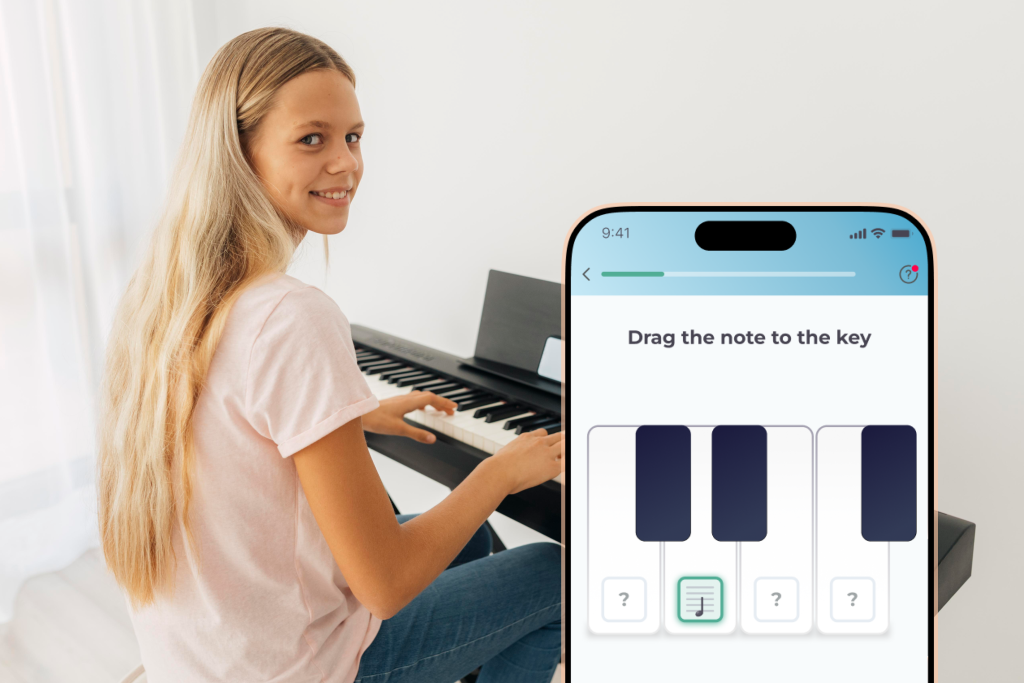
Talented is not just a platform for learning keyboard skills but a flexible tool adaptive to the personal requests of every author and composer. In contrast to traditional courses, the basic technical skills are taken into consideration here, and more importantly, the specific creative tasks that the musician sets himself. The learning process is built around the following key factors:
- The user’s individual musical style. It can be rock, pop, jazz, electronics. The user chooses the genres close to his or her creativity. Further, this allows forming exercises that draw attention to the characteristic chords, rhythms, and melodic lines of the selected style.
- The author’s goals and objectives. If, for instance, the main priority is the fast creation of basic arrangements, more time is spent by the program on practical techniques which allow you to improvise on the keyboard without long hesitation. If it is technical perfection that is of the first priority, then the efforts are directed to hone the details.
- Flexibility in schedules and lesson formats: one can choose between short daily trainings, longer weekend sessions, and also formats — from video lectures to interactive workshops.
The user feels that, as a result of interacting with Talented, learning stops being a set of unconnected exercises, but it becomes an organic part of the creative process, a tool helping to reveal his own musical ideas precisely. This fosters practice inspiration, creative workflow, and composition feedback for arrangement practice and songwriting prompts. This is where Talented for creators and composer practice become daily utilities.
Talented’s Unique Methods for Developing Musical Ear and Playing Technique
The main advantage of Talented is special approaches to developing not only technical skills but also musical ear — a factor without which it’s impossible to create expressive keyboard music. Among its characteristic methodologies, the following stand out:
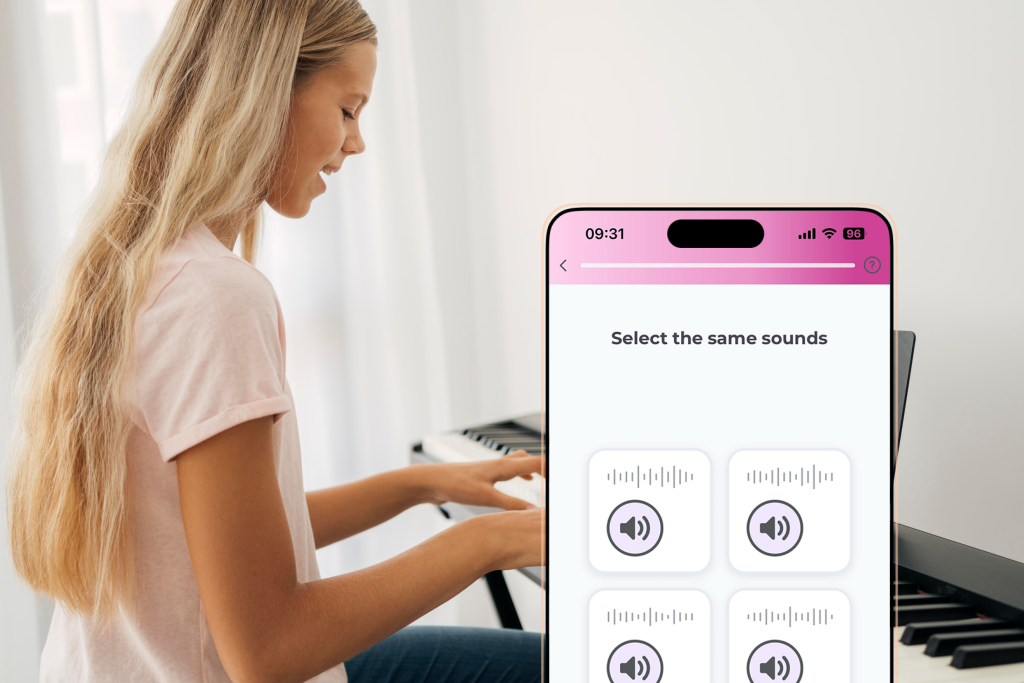
- Systematic recognition of intervals and chords: by using integrated auditory trainers that will gradually become more complex and adapt to the student’s level. This exercise will enable students to understand more quickly the harmonic dependencies in their own composition.
- Live ensemble simulation: the user will learn to keep the rhythm, adapt to harmony, and feel the overall musical picture while playing with virtual instruments or a rhythm section.
- Chord Chains methodology: unique trainer where chords and their sequences change in an unpredictable order, developing reaction speed and building confidence in playing.
- Personal technical exercises for the development of chosen finger groups, coordination, and dynamics, adjusted to the author’s musical intentions.
Such an approach lets songwriters and composers learn not just how to play notes but to feel the language of music, to understand the connections of nuances and dynamics that significantly expand creative horizons. Each lesson turns into an exciting exploration of new keyboard possibilities, and the result is bright, vivid musical works. Here, keyboard drills and harmonic exercises reinforce chord voicing and melody development.
Using Keyboard Skills In The Process Of Song And Arrangement Creation
Before authors and composers, the mastery of keyboard instruments opens a whole series of new opportunities, significantly expanding the creative arsenal. Not merely a technical skill does keyboard playing become but a powerful tool that comes to help in bringing musical ideas into life.
First and foremost, keyboards allow for convenient harmonic experimentation. The possibility of quickly and visually choosing chords, changing modes, or creating unusual harmonic transitions on piano or synthesizer does much to simplify the composition process and reduces the time spent in the search for new sounds.
Secondly, the keyboard skills allow one to create full-sounding demos with ease, while simultaneously including melody, bass, and rhythmic foundation. Free usage of both hands is very important here, distributing parts across different voices:
- Usually, the left hand forms the bass line and rhythmic pattern, setting the track’s foundation.
- The right hand is responsible for the melodic and harmonic elements that provide life to the composition.
Moreover, keyboards are a very good helper in developing the arrangement. There is no need to be limited to just a melodic line or chords in one’s head. On the keyboard directly, it is possible to hear how different instruments sound in the score, vary timbres, layer tracks, and adjust the balance.
Playing skills also contribute to better communication with producers and musicians because the author is presenting his musical ideas personally; therefore, no misunderstandings or need for translations from notation into sound language occur. This speeds up the working process and allows for a higher quality of the final product.
Main fields of application of keyboard proficiency:
- Creating harmonic foundations and arpeggios for songs.
- Creation of complex demos without necessarily involving other musicians.
- Development and tuning of arrangements in real time.
- Improved communication with colleagues in studio and concerts.
- Quick experimentation with sound and composition structure.
Not just a skill, but mastering keyboards is a fundamental base. It allows authors and composers to act more confidently and effectively, to transform musical ideas from abstract images into tangible, lively works. These songwriter tools translate directly into creative drills and arrangement practice that lift keyboard fluency.
Real Success Stories — How Learning Keyboards Unleash Creative Potential
Inspiring feedback from users we get on a daily basis — stories reminding us why this app was created.
Not just playing notes after a few weeks of lessons, but composers and songwriters for whom mastering keyboards was hitherto an unreachable dream started bringing out emotions and ideas that could never have found expression before.
What makes these success stories different? A number of telling factors:
- An individual approach.
A program tailored to the style, goals, and pace each musician gets upon joining the training removes the usual feeling of “getting stuck” and makes practice a creative process, not a routine. - Practical application from day one.
After just one month into the classes, the students are able to use their skills in simple melodies and arrangements, which actually motivates them so much to continue and develop further. - Developing musical ear, not as an abstract goal, but as a tool for daily creativity.
Thanks to certain exercises, many of them substantially improved their perception of harmony and rhythm, which is directly reflected in the quality of their compositions.
Concrete examples:
- “Before, I couldn’t even play the simplest chords,” shared Alexey from Moscow, “now whole emotional pictures are born on the keys which I used only to describe in words before.”
- Irina from Saint Petersburg noticed with surprise that, having mastered the basics, she began to understand the musical structure of her songs much better and started experimenting with new arrangements.
- Artem, a young composer from Novosibirsk, noted that feedback and hints in the app helped him fix mistakes at early stages with confidence to move further.
Each of these stories is more than proof of effective methods; each vividly confirms how keyboard mastery allows the author to expand his own creativity. That we help specialists not only to learn but really open new horizons in music — we take pride in this. After all, inspiration often comes through the instrument that has become an extension of the artist themselves. This showcases creative feedback loops that strengthen composition skills and practice inspiration.
Why Keyboard Mastery Matters Today
“Today, mastery of keyboard instruments is more than skill; it constitutes a basic element of successful creativity for authors and composers.”
Why? The reason is in a few principal aspects that shouldn’t be underestimated:
- Range of arrangements and harmonies
Keyboards allow working with chords, creating complicated harmonic structures, and making changes easily right in the work. Such a keyboard will significantly extend the creative arsenal of an author. - Development of musical thinking
Difficult it is to replace keyboard playing with other instruments from the point of understanding music theory. More obvious and vivid become notes, intervals, and keys. Consequently, ideas are embodied faster and more precisely. - Autonomy within the musical creation process
The composer who can play the keyboard is not dependent on other musicians for initial sketches, and that speeds up the process leading to a far more complete realization of the concept. - An instrument for integrating technologies and modern sounds
Keyboards blend perfectly with MIDI gadgets and software synthesizers, opening limitless possibilities in the creation of unique sounds and track arrangements.
Thus, Talented teaches not just to play but shapes in the songwriter and composer new freedom and control over the creative material.
It is wildly important to understand that keyboards become the key to making the sound more expressive, reflective, and professional.
If growth in the music industry is what one strives for, then keyboards form the very foundation to rely on. With Talented, mastery of this instrument will ensure:
- Concentrated learning with the consideration of personal goals;
- More motivation and deeper understanding of the music;
- The possibility to compose more complicated and emotionally saturated pieces.
That is why keyboard mastery is by no means only a skill but also an organic part of modern music creation. It is this kind of mastery that really allows songwriters and composers to unlock their full potential and take their creativity to another level. Here, Talented for creators connects composer practice with keyboard drills plus creative feedback to power chord progressions, songwriting tools, and melody development.